
Complex Oedipus
Anthony Burgess revisits Greek and Roman myths

Christopher Nolan’s film adaptation of The Odyssey, which has already gained positive reviews, promises to update Homer’s epic poem with new resonances for modern audiences. However, this is merely the latest iteration of a story which has been retold for more than 2500 years.
The 1920s was a fertile time for revisiting and updating classical mythology. James Joyce’s Ulysses condenses the ten years of Odysseus’s journey into a single day in twentieth-century Dublin, relocating episodes such as the Cyclops and the Oxen of the Sun to quotidian settings, without ever losing sight of the original Homeric material. In The Waste Land, T.S. Eliot takes a different approach, blending elements of Virgil’s Aeneid, Ovid’s Metamorphoses and the Satyricon of Petronius with allusions to world literature including the Grail myths, Shakespeare, Dante, the poetry of Charles Baudelaire and Paul Verlaine, Wagner’s operas and the Sanskrit Upanishads.
Anthony Burgess read Ulysses and The Waste Land as a schoolboy in the 1930s. He was also studying two books of The Aeneid for his Higher School Certificate in Latin. In the first volume of his autobiography, Little Wilson and Big God, he claims to have taught himself Greek so that he could translate the pseudo-Homeric odes. Reading the works of Joyce and Eliot showed him the creative possibilities of updating classical myths.
Burgess’s first novel, A Vision of Battlements, draws on his experience of living in Gibraltar during the Second World War, and on his knowledge of Virgil’s Aeneid. Although the first draft was completed in 1952, the novel was not published until 1965. Whereas Joyce had borrowed from Homer, Burgess took Virgil’s Aeneid as the structure on which to hang a twentieth-century story about a man who survives a war and goes on to build a civilisation.
A Vision of Battlements follows the disgruntled soldier and aspiring composer Richard Ennis, who is stationed on Gibraltar with the Royal Army Educational Corps. Sergeant Ennis is a modern version of the warrior Aeneas, and his deadly rival, Turnus, is translated into a muscled gym instructor named Turner. Burgess uses a Roman myth to build a story with universal themes. He describes how myth formed the thematic core of the novel:
The Virgilian references are not all pure fancy. Aeneas the Trojan has the task of founding the Roman empire. The Catholic and half-Irish Ennis has two tasks — one imposed on him by the British Army, the other springing out of his own musical ambition. In an age of chaos he wishes to create great music that mirrors the cosmos. The army tells him to teach the troops how, through freshly developed democratic techniques, to build a Utopia.
Many of Burgess’s novels of the 1960s contain mythic elements, though only one other book uses it in a structural way, borrowed from Joyce. The Worm and the Ring, published in 1961 and set during the Festival of Britain ten years earlier, is a modern updating of Wagner’s Ring Cycle, itself drawn from the epic German Nibelungenlied. The mock-heroic setting of Burgess’s novel is an Oxfordshire grammar school (a kind of Valhalla), and the story follows Christopher Howarth, standing in for Wagner’s Siegfried, who is in love with a female teacher, Hilda Connor, a Brünnehilde-figure. The novel includes a quest to find a schoolgirl’s stolen diary (in place of Wagner’s Rhine-gold, stolen from the three Rhine maidens), which reveals damaging fantasies of a seduction by the school’s headmaster (Mr Woolton, or Wotan). As in A Vision of Battlements, Burgess draws on his recollections of a real place — he spent four years as a school teacher in Banbury in the 1950s — through the prism of an ancient story.
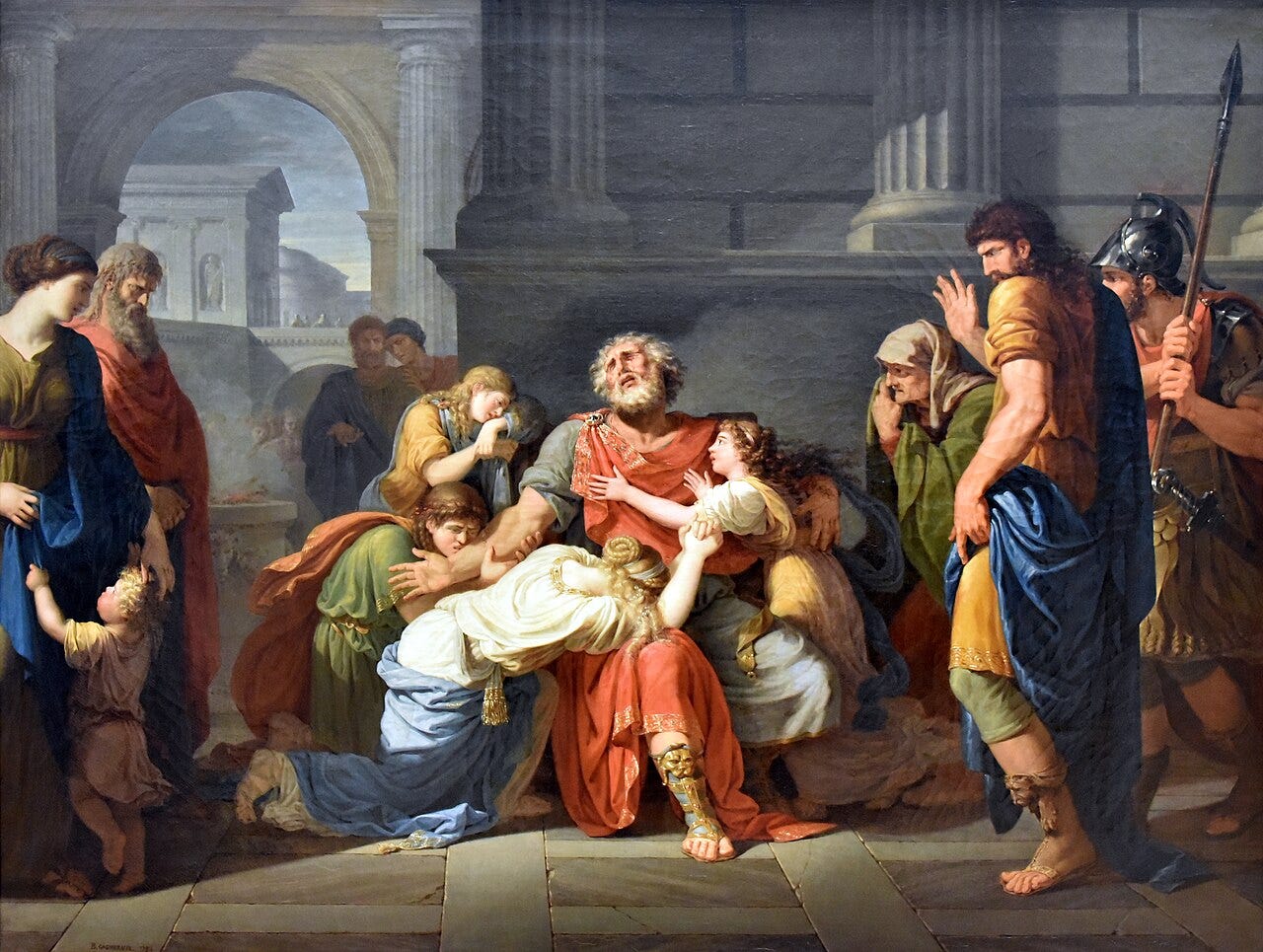
His urge to adapt classical mythology continued in the 1970s. His novels M/F and Beard’s Roman Women offer further examples of updating mythical narratives. We have already described his use of the Orpheus myth in Beard’s Roman Women in a previous newsletter (see the link below). M/F, published in 1971, takes the central elements of its plot from Oedipus Tyrannos by the Greek playwright Sophocles.
The novel’s title is perhaps explained by events in the original play, although Burgess pointed out that it might also stand for male/female, or Miles Faber, who is the protagonist of the novel, and whose name suggests a creator and destroyer. M/F draws on Burgess’s memories of living in the United States, Malta and Italy, and it blends Greek mythology with the structuralist theories of Claude Lévi-Strauss, particularly his book The Scope of Anthropology.
In the novel, Miles Faber leaves New York to embark on a pilgrimage to the Caribbean island of Castita, where he hopes to find the works of a mysterious artist and composer called Sib Legeru. Castita is a strongly Catholic island where Miles meets his identical twin, encounters a circus performer who trains birds of prey, and finds himself drawn into the web of a family he has never previously met. Beyond the mythical and theoretical influences, there are echoes of Joyce and Thomas Pynchon. Of the novel, Burgess writes:
Lévi-Strauss had discovered that the incest-riddle nexus was to be found not only in the Oedipus myth but also in the folklore of the Iroquois and Algonquin Indians. What I saw in the legend was the possibility of composing a contemporary realistic novel in which all the structural desiderata were fulfilled without the uninstructed reader’s needing to know or care.
Burgess claimed that M/F was the best among his novels, though he worried that the reading public was not ready for it in 1971. He returned to the Oedipus myth the following year with a free translation of the Sophocles play, commissioned by the Guthrie Theatre in Minneapolis. The play included strange music by the composer Stanley Silverman, including chants written in an invented language resembling Indo-European. Burgess later said that translating the play ‘solved, or seemed to solve, the riddle I had been asking myself while writing M/F.’
Burgess’s thinking about classical mythology was formed by more than forty years of study and translation — and, in particular, by his knowledge of Joyce’s Ulysses, The Greek Myths by Robert Graves, and modern musical works such as Stravinsky’s Oedipus Rex (1927). He also cited Jean Cocteau’s Orphée and Pier Paolo Pasolini’s Oedipus Rex (1967) as cinematic influences on his mythological novels. His wide knowledge of the tradition of Western literature, and of the work of contemporary writers and film-makers, allowed him to create highly original neo-classical novels which resonated strongly with readers.
Find out more
M/F by Anthony Burgess (affiliate link)
A Shorter Ulysses, edited by Anthony Burgess (affiliate link)
Ulysses by James Joyce (affiliate link)
The Waste Land and Other Poems by T.S. Eliot (affiliate link)
The Greek Myths by Robert Graves (affiliate link)
A Vision of Battlements by Anthony Burgess (Manchester University Press)
Beard’s Roman Women by Anthony Burgess (Manchester University Press)
Buying books from the Burgess Foundation’s affiliate bookshop (powered by Bookshop.org) supports our charitable work.
Read about Beard’s Roman Women, Anthony Burgess’s novel inspired by the Orpheus myth, in a previous newsletter:


Please tell me I don't have too much longer to wait for The Worm and the Ring to be re-published!